Personal Story from one of our members.
When you grieve for what was… 🙁 🙁 🙁
A couple of kind, enquiring messages from friends recently made me realise that I haven’t really posted much about my health and what’s been going on for the last year and a half, so I thought maybe I should do an ‘update/explainer’, so here we go.
In summary, for the last year and a half, I’ve been living with Chronic Fatigue Syndrome (ME/CFS). It’s a very weird, and poorly understood condition, where your body, and mind, to some extent just ‘shut down’ on you. The mechanisms as to how and why that happens are many and varied, so every case is different, and for decades research has been underfunded and progress very slow, but some potential answers (but not cures) are starting to be found. Most of you will have heard of Long COVID, well that’s kind of what this is, there seems to be a lot of commonality between the two, and the research that’s going into Long COVID will hopefully also shed some light on ME/CFS.
How did I get it? Good question; mine was precipitated post-virally, which is very common. After a very hectic work contract from late 2018 to 2019, I took some time out and had a month’s holiday visiting friends in Cairns, felt good, ate well, relaxed, exercised, started to get a little bit of the fitness I’d lost over the previous year back. Then I got on a plane to the UK for my first Christmas with my family in 12 years. I say ‘a plane’, but it was actually five flights over four days (don’t ask!) and along the way, I picked up something ‘ flu-like’. Was it actual flu, rather than man-flu; well I was laid out in bed for the best part of a week, and laid out in a chair for a week after that, fortunately being taken very good care of at my parents’, but not the start to the trip I’d planned. (Side note: was it COVID? Hmm, yeah could have been, it would have been very early even though evidence suggests COVID was already spreading at that time, and my symptoms were definitely more conventional flu than COVID.) I continued to feel pretty flat for the rest of the month I was in the UK. Whereas I would normally get out for an hour or more run every day, or a swim, when I’m travelling, the best I managed that trip was a gentle walk.
I got back to Rotorua on Wed 8th Jan 2020, excited to be back for summer and with plans to train up for Cairns half-Ironman at the beginning of June. COVID would have scuppered that plan in any case, but as it turned out that was the least of my worries. Keen to get back to training, on Sunday I dusted off my tri-bike from the garage, and set off for a steady ride around Lake Rotorua to set a baseline. The ride around the lake is pretty much bang on Marathon run distance, 42km, and would normally take me about 1hr20m at a reasonable pace. A few ups and downs but no really big hills and some nice fast, flat sections to enjoy. An hour and twenty minutes into the ride I was only two-thirds of the way round, feeling like death, and seriously considering phoning a friend to pick me up and take me home. Fortunately the last third of the ride is flat and easy, so I switched into survival mode and limped home in a bit over two hours and went to bed. Looking back at my diary, it’s empty for the next four days.
Then I woke up on the Friday feeling ‘better’, so I decided to try my regular 5.5k run loop through the forest. It’s a beautiful little run that always makes me feel better just for being in that environment, and would normally take me 30-35m at an easy pace. It didn’t make me feel better that day; I got home, after walking half of it, in 52 minutes, and was coughing up blood, never a good sign! Again, I fell asleep before I could shower and my diary is empty for the next four days, although somewhat hilariously it has reminder that same day to work out my training plan for Cairns, with a smiley face  Oh the irony!
Oh the irony!Something was clearly very badly wrong, so I headed to my doctor, who arranged a range of tests; blood, urine, stool and more. Pretty much everything came back normal, as it does for ME/CFS as there’s no commercial diagnostic test for it as yet, but my white blood cell counts were very low, meaning my immune system was struggling and my health vulnerable. My doctor said that it was likely I had post-viral fatigue, where you have dealt with a viral infection, but despite the immediate threat being over your body and immune system don’t recognise that, and are still on full alert and pouring a heap of energy into trying to fight an infection that is no longer there. Imagine all those flu symptoms; pain, aches, nausea, sweats, lethargy, exhaustion, they are all symptoms not of the virus itself, but of your body fighting the virus and spending all its energy on that fight to protect you. The only prescription is rest, eating well, and trying to reduce any kind of stress on the body and mind, in the hope that at some point the body realises the threat is gone and your immune system resets back to its normal standby state.
With COVID by that point spreading very rapidly around the world, and inevitably reaching NZ, I did a big shop, stocked up the fridge, freezer and cupboards, and went into voluntary self-isolation, as had I caught COVID at that point it almost certainly wouldn’t have ended well. Several weeks later the whole of NZ went into our first lockdown, which for me was perfect timing; I couldn’t go anywhere or do anything, but no one else could either, which was at least good for my mental health, and gave me the perfect ‘excuse’ (not that any was needed) to keep on resting.
On the odd day that I did feel ‘good’ I would get out of the house and go for a walk, but me being me of course it wasn’t a walk, I went out ready to run, and ran what I could! Which I now know was very stupid! Each time I would end up cutting my plans short as my heart rate went ballistic and I struggled for breath, walking/shuffling home to crash again, back in bed for days, crawling only to the loo, and back again via the kitchen cupboard to grab a cereal bar so that I had ‘eaten’ something. So much for eating well to help with my recovery!
Fortunately, I started to see this pattern, and at the same time was starting to read up more on post-viral and chronic fatigue. It turns out that one of the many conditions that make up ME/CFS is a thing called Post Exertional Malaise (PEM). Unlike the normal tiredness that you might experience immediately after a big exercise session, this comes on 24-48 hours later, and is pretty much all-consuming. And with my body and immune system in the already hugely stressed state they were, my ‘good day’ ‘walks’ were the perfect big hits to land me back in bed again. Bits of the jigsaw were slowly starting to fall into place for me to understand what was going on a little better.
Time passes slowly, but in July last year I was lucky enough to stumble across a support organisation called Complex Chronic Illness Support (CCIS) who work with people living with a number of conditions, including ME/CFS. I filled out an application form, met their criteria, and was assigned a support officer who gave me a call and we had a great chat about what was going on and where I was at. First things first; you’re not mad, you’re not making it up, you’re not seeking attention, this is real, very real, but little recognised, and your typical GP is, as mine was, very ill-equipped to deal with it. I filled out what is called a ‘pacing diary’ for about a month; what I did each day, what I ate, how I felt, and started to put more pieces of the jigsaw together. Seeing the delayed connections between what happened one day and how I felt several days later, working out what they call my ‘energy envelope’ or how much (how little) I can do without doing too much and causing a crash.
And boy was that a wakeup call! As lockdowns eased I made plans to meet friends for a coffee; the local eatery is an easy twenty minute walk away, and having coffee with a friend can’t be tiring can it? How wrong can you be? Wake up feeling good, it’s a sunny day, walk to the coffee shop, catch up with a friend for an hour, oh, now I have to walk home, shuffling by the time I get there, but I need to go and do some shopping, so into the car, drive to the supermarket, do my shopping, drive home, and I can barely walk up the dozen steps, stopping at the top to catch my breath. I get inside and throw a couple of frozen thing in the freezer. The rest gets left in bags and I crash again –“F*&K! IDIOT! Don’t beat yourself up Bren, you’re still learning about this, don’t be so hard on yourself, no stress remember!” Four days later I unpack the rest of the shopping.
The five bikes in my garage are just gathering dust, waiting for when I ‘get better’. In the six months since I got home I’ve been out on my mountain bike a handful of times, a ‘duty’ ride, because it’s a sunny day, and the forest is on my doorstep, and the bikes are gathering dust, and I ‘should be’ out there, exercising, enjoying it. I ride the flat route around the forest, half an hour at a very pedestrian pace, to the coffee shop on the far side, stop for coffee and cake, then I grind up the forest road in my granny gear and I finally get to have three minutes of fun on the final downhill out of the forest. So I buy an e-bike, and even I wince at the price! But it’s a game-changer, it does the work for me, it makes the forest fun again, I ride with a huge grin on my face, and explore new trails, because if it goes the wrong way, or uphill, well the bike will get me home. Well, as Kiwis like to say, yeah nah!
Friends are going for a ride so I join them. Two hours later I’m exhausted, Despite the bike ‘doing the work’, I still have to put some effort in, turn the pedals, I have to be physically and mentally switched on even if I’m not doing much work uphill, and once we hit the downhills I really have to step it up a notch, up out of the saddle, balancing, moving my body and the bike around, concentrating. My heart rate has gone through the roof again, and I limp home to crash out once more. Lesson learned, just being physically or mentally present for too long can knock me out for a week!
More info from CCIS; it turns out that one of the doctors at my local health centre (just next to the aforementioned coffee shop!) is the daughter of NZ’s leading, and world leading, expert on ME/CFS. Mum has been researching it since the 1960’s, and has written what is pretty much ‘the bible’ when it comes to understanding the condition from a layman’s or GP’s point of view, and her daughter, to whom the knowledge had been passed, is my local GP! My ‘current’ GP at that time was, and had been, wonderful, had seen me through suicidal depression, but the chance to enrol with someone so far ahead of the medical pack for ME/CFS was far too good to be passed up. So in August 2020 I enrol with my new GP and book a half-hour appointment.
I mentioned at the start of this that ME/CFS affects your brain too, and I’m finding thinking increasingly difficult. Those catch ups with friends are hard work because conversations tail off as I struggle to remember what I was going to say, not once or twice because let’s face it I’m not getting any younger, but every sentence I start. So in the days before my appointment I make notes of the things I want to bring up, and it’s not a short list. But I meet my new doc and we start going through it. The same reassuring message, you’re not mad, you’re not making this up, I believe you. I cry with relief; I’m in the right place to get the best help I can. An hour later we’re still chatting. Who gets an hour with their GP? No one. But I did!
We talk about my sleep. I get plenty, more than, except when I don’t, but no matter how much I get I still wake up feeling like I’ve been run over by a freight train. I’ve always been lucky enough to be a good sleeper, but now sleep brings no refreshment. Another symptom of the immune system and body being in a permanently stressed state; because my body is on high alert I never reach a state of proper, deep, refreshing sleep. And because my body doesn’t reach that state in an eight hour sleep it decides it should try sleeping longer. Nine, ten, eleven, twelve, thirteen and fourteen hours, eyes open, body aches, mind numb, hit by a freight train again last night.
Well if more sleep isn’t making me feel any better, then my body decides we might as well not bother sleeping. Thank god for my antidepressants, which are also a pretty good sedative, except on the odd occasion I forget to take them in the evening then find myself in a state of wide-awake complete exhaustion, staring at the walls at three o’clock in the morning, so devoid of energy I can’t quite work out how I’m not dead, but painfully alive.
Still the diagnosis remains little changed; now classified as Chronic Fatigue rather than post-viral, as it’s been more than three months, and as Syndrome, because it’s not just tired, it’s the PEM, and the aching muscles, although I don’t have the excruciating pain that some have, the crazy spiking heart rate that comes with the most minimal exertion, and the sleep, sleep, sleeping, and the not sleeping. And the ‘brain fog’.
My doc asks me about the notes I’d made, we talk about ‘brain fog’, and I mention the recent episode in the supermarket. Doing a little shop, a list of a few items on my phone in one hand, a shopping basket in the other, and standing in the aisle completely lost, not knowing where I was or why, an experience I can only liken to Alzheimer’s, terrified, time standing still, and then slowly comprehension returning; find the things on the list, put them in the basket, you’ve got this. OK, that’s good, but now I have to drive home…!
Brain fog, it turns out, is common with ME/CFS, as is clumsiness, since the brain and central nervous system need Vitamin B12 to function, but in some people with ME/CFS, for reasons unknown, the blood/brain barrier stops letting enough through, and brain/CNS signaling becomes slow and chaotic. No wonder conversations are hard, no wonder the concentration of a mountain bike ride is exhausting.
Another barrage of tests is ordered, sixty or seventy different things to be checked, to rule out a dozen or more conditions that could have similar symptoms, and to check my B12 levels. It turns out my blood B12 levels are normal, so we’ll try injections which will give me mega blood B12 levels, so even if only a fraction gets through then my brain will have enough. Ping! It’s like a switch being turned on; halfway through a series of six, weekly injections and I can think clearly again, a veil has been lifted, which is pretty damn handy as it’s time to do my tax return which is never simple at the best of times! I finish the six-week course, and I go to monthly injections, then try a stretch without them again. Two months in and I can feel the fog starting to creep back, but let’s experiment. We get to three months and things have really slowed down again and it doesn’t feel good, so two more monthly injections and then we’ll go to two monthly.
More pieces of the jigsaw fall into place, but the prescription remains much the same. Rest, rest, rest, destress the body and mind, eat well, a couple of supplements to try that may make a marginal difference, a little gentle exercise but be very careful with that energy envelope, every time you overreach you risk setting yourself back and stopping or slowing any potential recovery.
And what are the chances of recovery Doc? Not great, 95% of people with ME/CFS will be permanently disabled in some way compared to their previous selves. Some will end up bed-bound and being fed through a tube, with permanent care, some will get almost back to ‘normal’. I’ve come a long way from constant push/crash cycles and days in bed, and so long as I’m sensible I have a good chance of making further progress, but how far I get and how long it takes only time will tell.
As I write this, a year down the track, I have anything between two to four hours of ‘useful’ time most days, but let’s be clear what useful means. Useful time is when I have enough energy for a shower, the rest of the time I just wash my pits and bits with a flannel; it’s not like I’m working up a sweat very often. Useful time is when I run the stick vac around the house, or clean the shower. It’s when I do some shopping and get some fresh food in so I’m not dependent on microwave meals (although I’ve found some great ones which have been a lifesaver). It’s when I have a doctor’s appointment or a Vit B injection, or get out for a walk and some fresh air. Useful time is when I cook up a giant pot of chilli or curry, enough to make a dozen servings to freeze, but it’s also when I finally throw out the veggies I bought a month ago with good intentions, which are now rotten and stinking in the fridge. It’s when I wash the dishes that have been sitting in the sink for a week.
In between I nap, rest, doze, chill. I wake up and take my time to get moving, have some breakfast, I do a little errand, I rest, I make a sandwich for lunch, I read a few pages of my book, I rest for the afternoon, I watch some TV, have some dinner and go to bed. Some days good, some days not so good. And some days I still do more than I should, like head off on a four-day road trip, even though others are covering the same trip in two days, and then I pay for it with four days of recovery.
And why me, why now? Well it turns out I’ve probably been building up to this for most of my life in one way or another. I’ve always put a huge amount of pressure on myself to ‘achieve’; not in a material way, not status, or possessions, though I had been lucky enough to be ‘successful’ in terms of setting myself up for the future, at least until this struck. But I’ve always pushed myself extremely hard in my various careers. That’s been hugely rewarding, and I’m fortunate to say that I’ve left my mark in a good way on some of the biggest organisations in various fields, but it’s come at a cost, and I’ve had a pattern of pushing too hard, taking a break, recovering ‘a bit’, and then pushing again. I’ve had roles at the very top-level as a side-gig to my stressful ‘day job’, I’ve emigrated, watched my marriage fall apart, built up a successful business and seen it crumble as I fought depression, and slowly built myself back up again. And my release from that has been exercising, training and competing in endurance sport, smashing myself on an evening run or bike workout to forget about the stresses of a busy day, and then racing at the weekend, or driving thousands of miles to spend a long weekend kayaking alpine rivers only to drive home again and hit work running the next morning.
And at the time it felt good, but it’s very clear looking back that my body, and mind, have been crying out for a long time for me to slow down and take it easier. But I didn’t listen, and so finally instead of a temporary crash, this time I’ve just dropped off the edge of a cliff! And in an odd way that’s been a good thing. Whereas previously I would have recovered a bit and then tried to push through, and it’s clear I still tried to do that to some extent this time, it’s also clear that this time the crash was so utterly overwhelming that I’ve had no choice but to surrender to it. And while that’s taking a lot of getting used to from a physical perspective, it’s been really helpful for my mental health, as I haven’t tried to fight what’s happening, and have been, surprisingly, much more accepting of my situation than I would have expected. And I’ve recognised that even if I do recover well physically, ‘old’ me, the one who pushed himself so hard he just about exploded, he’s gone, and that’s good, that’s how it needs to be.
Which is, in a way, what’s brought me to writing this, and that photo up top. I haven’t worked for over two years at this point, and although my financial situation isn’t bad, I’m effectively ‘retired’ seven years and a million bucks of earning potential earlier than I’d planned. Some of those investments that make my tax return such a mission have done well, others less so, and some have changed just during this time so that I might do well long term, but income has dried up. So, for the first time in my working life, I looked into whether I can get any support, and it turns out I can, which might help with getting the lawns mowed, or a cleaner, or someone who can cook something with those fresh veg I bought, before they go rotten. Of course, as part of that, I have to prove my situation, both financially, for which my wonderful accountant is rushing through this year’s tax return, and my amazing GP has given me a disability certificate, which I picked up this morning.
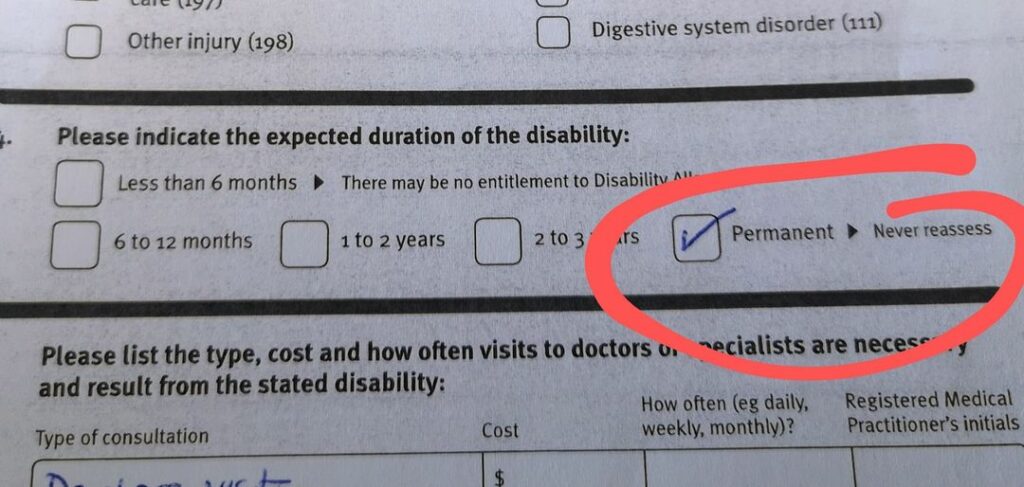
And that’s when it hit me, written in black and white for the first time:
“Please indicate the expected duration of the disability:” “Permanent”
F*&K! Again!
There are no guarantees with this. I might be lucky and get significantly better physically over time, but realistically the odds aren’t good. Truth is I probably will get a bit better, and I’ll keep learning how to manage my energy and not push the envelope too far. But that beautiful tri-bike that’s still sitting gathering dust probably isn’t going to get used again, at least not by me. That full Ironman that I’ve not managed to tick off probably won’t get ticked off, however slow and low I set my sights. Those kayaks that used to take me down alpine rivers, through gorges that most people will never see or experience, probably won’t get wet again, not on anything other than a flat lake. Even if I wanted them, those busy, stressful jobs are a thing of the past, but so are the satisfaction and rewards of turning a place around. Things that have for most of my adult life defined (for me) my identity, who I am, what I do, that may never see the light of day again. And that’s hard.
I’d thought I was doing alright dealing with all of that until this morning. I’d been feeling pretty flat for the last couple of months since getting back from my long trip to the UK, but I’d put that down to just settling back in, and realising that although I was very lucky to be able to go, and very well looked after while I was there, actually just being away had been exhausting. Not surprising when global travel is tiring at the best of times, and adding COVID tests, travel uncertainty, isolation at each end, and my Dad’s frail health being the reason for my travel in the first place made it an emotionally exhausting trip. And I thought I was still just dealing with that.
But it turns out that after a year and a half I’m just starting to grieve for what was. And that’s good, it needs to happen, it’s part of the process, it’s something my doc mentioned, and something CCIS talk about with their support.
And it’s gonna take a while! If my previous experiences of grief are anything to go by there’ll be a lot of work to do, but writing this has been the start, and if you’ve got this far thank you for reading, and I hope it’s helped you understand where life is at for me right now. It’s taken all day to write, cos you know, concentration and brain fog, and crying! And it’s been exhausting, but very cathartic, so I’ll sleep well tonight (even though I’ll still feel like I’ve been hit by that freight train in the morning!)
Things to be grateful for:
My wonderful family, I am so, so lucky!
My amazing friends, all of you, again, I am so, so lucky!
Sunshine! And refreshing rain!
Coffee! And water! And gin!
All the amazing things I’ve had and done in my life!
All the amazing things I’m still going to have and do in my life!
And…
Every!
Damn!
Day!
I’m!
Still!
Alive!
Because this isn’t a pity-party, or a poor me post; in amongst all the changes, life is still damn good, and I’m still bloody lucky!
See you out there whanau! Do what you love, love what you do, and be grateful for all of it!
